Showing posts with label space. Show all posts

Tuesday, October 23, 2012

Low Friction... in Space!

Everybody loves low friction right? Without it cars wouldn't run well, machinery would come to a grinding halt, and men like this wouldn't have any fun at all.

In fact, almost everything we know and love wouldn't work correctly if low friction lubricants like oil hadn't been invented. It's a huge industry here on earth.

But what about in space? We don't want friction up there do we?

We certainly don't. But conventional lubricants won't work up there because of the low-gravity and extreme temperature differences encountered. None of the oil would stay where it needs to be, and it would gel up like strawberry jelly that's been sitting out too long. Neither of which are any good for the cause of reducing friction.

I recently had an opportunity to interview the owner of a high-tech coating company, Tribologix. They do very low friction coatings that are ingrained into the metal of the parts that have been coated. This makes for a great low friction surface that won't gum up, squeeze out of the part, or wear away over time. These coatings have been tested on the ISS, and the gears on the mars rover have been coated like this. There hasn't really been much research on lubrication and friction in space because, well, you have to test in space. The lubrication business has just begun to start testing in space to find better alternatives to the relatively poor space lubricants we have now.
A tribometer (friction tester) going to the ISS. Source
With more testing and development, making parts move in space will become easier and easier, and extremely costly failures like this won't happen nearly as much.

-Colin Downs

Sunday, September 30, 2012

Extremely Deep and Hubble-y Close


Remember the '90s? When we had such amazing picture taking technologies as Polaroid cameras? When cameras used to look like this:
Polaroid technology at it's finest!
Yes well that was also when we sent the Hubble Space Telescope into orbit. That bad boy is a 7.9 foot aperture telescope that can see near ultraviolet rays, near infrared rays (like predator), and visible light rays. Us humans can only see the visible light rays (hence the name visible light). It's the only telescope that's designed to be serviced by astronauts in space while orbiting and it orbits the earth 14 to 15 times per day. It has taken some seriously sweet pictures that opened our eyes to new images and sparked our imaginations as to what's actually out in the depths of space.
A picture from the Hubble
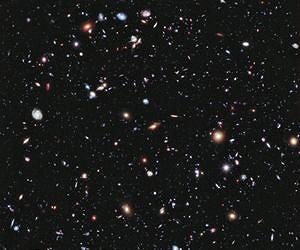
So what does this picture and the Hubble have to do with deep space? Well, over the past 10 years the Hubble has been taking pictures for NASA and all of those pictures were patched together and created the eXtreme Deep Field (XDF) photo. This photo is the deepest that we have ever been able to see into space:
This image is the deepest we've ever seen into space XDF
 That image has 5,500 galaxies in it. The Hubble detected all of those galaxies and some of them were one ten-billionth the brightness that the human eye can sense. That raises the question for me what more are we missing even on our own planet?
~Nate